Erte Beloved Sculpture
- Country: France
- Source: Paris
- Origin: 1987
- Size (cm): 44
- Material: Bronze
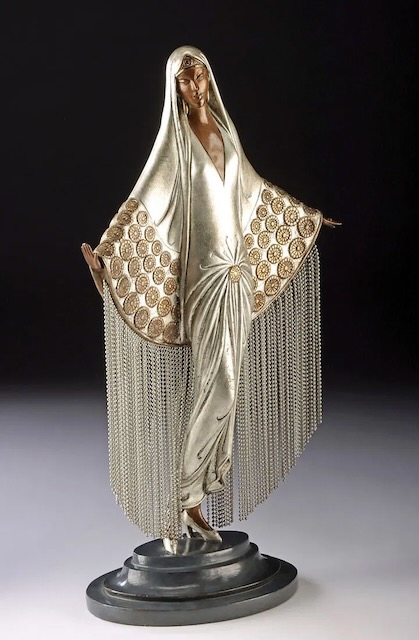
Erte also known as Romain de Tirtoff (Russian-born French, 1892-1990). “Beloved” old-painted bronze sculpture, 1987. Edition number 27 of 375. Signed, numbered, and dated on base with JM foundry mark for the Joel Meisner Foundry. A figure suspended between arrival and departure, “Beloved” presents one of Erte’s most theatrically draped women, her body nearly consumed by a great silver cape that spreads like wings to either side. The bronze is cold-painted in silver and warm gold, the cape’s surface ornamented across its full expanse with rows of embossed roundels suggesting embroidered coin-work, each rendered with fine radiating detail. From the cape’s lower edge falls a cascading fringe of fine ball-chain, a literal curtain of silver that pools the eye downward even as the figure’s gaze angles upward with serene detachment. The face is spare and masklike: high cheekbones, heavy-lidded eyes, a jewel at the brow. The figure advances on pointed toe, robes clinging in a single fluid column beneath the cape’s dramatic geometry. The exotic patterning of the roundels and the sinuous compression of the silhouette are signatures traceable to Erte’s earliest visual formation, the same vocabulary that animated his Harper’s Bazaar covers and Folies Bergere stage designs distilled here into cast bronze. Size: 10.5″ W x 17.25″ H x 5.5″ D (26.7 cm W x 43.8 cm H x 14.0 cm D)
About the artist: Born Roman Petrovich Tyrtov in St. Petersburg on November 23, 1892, Erte was the only son of an Imperial Fleet admiral and was raised among Russia’s social elite. His artistic instincts announced themselves early – at five years old he designed an evening gown for his mother – and were further shaped by the Persian miniatures in his father’s library, whose exotic, brightly patterned forms would echo through his work for the rest of his life.
In 1912, at nineteen, he left Russia for Paris and never returned. After a brief, discouraging stint at a minor fashion house, he sent his drawings directly to Paul Poiret – “Paul le Magnifique” – who hired him immediately. To protect his aristocratic family from the embarrassment of his chosen profession, he adopted the pseudonym Erte, formed from the French pronunciation of his initials R.T.
In 1915 he began his celebrated collaboration with Harper’s Bazaar, for which he ultimately produced 240 covers and approximately 2,000 illustrations, defining the visual language of the magazine through the 1920s and 30s. William Randolph Hearst, who secured Erte’s exclusive contract, reportedly asked: “What would Harper’s Bazaar have been if it weren’t for Erte?” Concurrently, Erte designed costumes and sets for the Folies-Bergere, the Ziegfeld Follies, and George White’s Scandals, bringing his taste for the exotic and his instinct for sinuous, lyrical form to the theatrical stage. A brief Hollywood sojourn in 1925 at the invitation of Louis B. Mayer proved less satisfying, though he contributed to productions including Ben-Hur.
After a quieter period in the 1940s and 50s, a major Art Deco revival in the 1960s returned Erte to prominence. At seventy-five he embarked on an entirely new creative chapter, producing limited-edition bronzes, serigraphs, and lithographic prints that made his work newly accessible to collectors worldwide. The French government recognized his lifetime of achievement with the title Officer of Arts and Letters in 1976, followed by the Medaille de Vermeil de la Ville de Paris in 1982.